There's a specific kind of frustration that shows up a few months after a cloud migration wraps. The project itself was, by every measure leadership tracked, a success. The dashboards were green. The milestones were checked off. The go-live happened on schedule, the stakeholders signed off, and the project team moved on to the next initiative.
And yet the business doesn't feel any faster.
Support tickets haven't dropped. People still complain that "the system is slow." The flexibility and efficiency that were promised in the original business case never quite materialized — or they showed up for a few weeks and then quietly disappeared. Nobody can point to a single root cause, because technically, nothing is broken. The migration worked. So why does it feel like it didn't?
It's tempting to blame the cloud platform itself — the provider, the pricing tier, the configuration. But in most cases, the platform is doing exactly what it's supposed to do. The real issue is almost always one layer down, in the infrastructure that was supposed to carry that platform and was never redesigned to do it.
Cloud migrations tend to get planned as software and platform projects. Someone decides where the workloads will live, what needs to be re-architected, what compliance boxes need to be checked, and what the cutover plan looks like. All of that is necessary. None of it is sufficient.
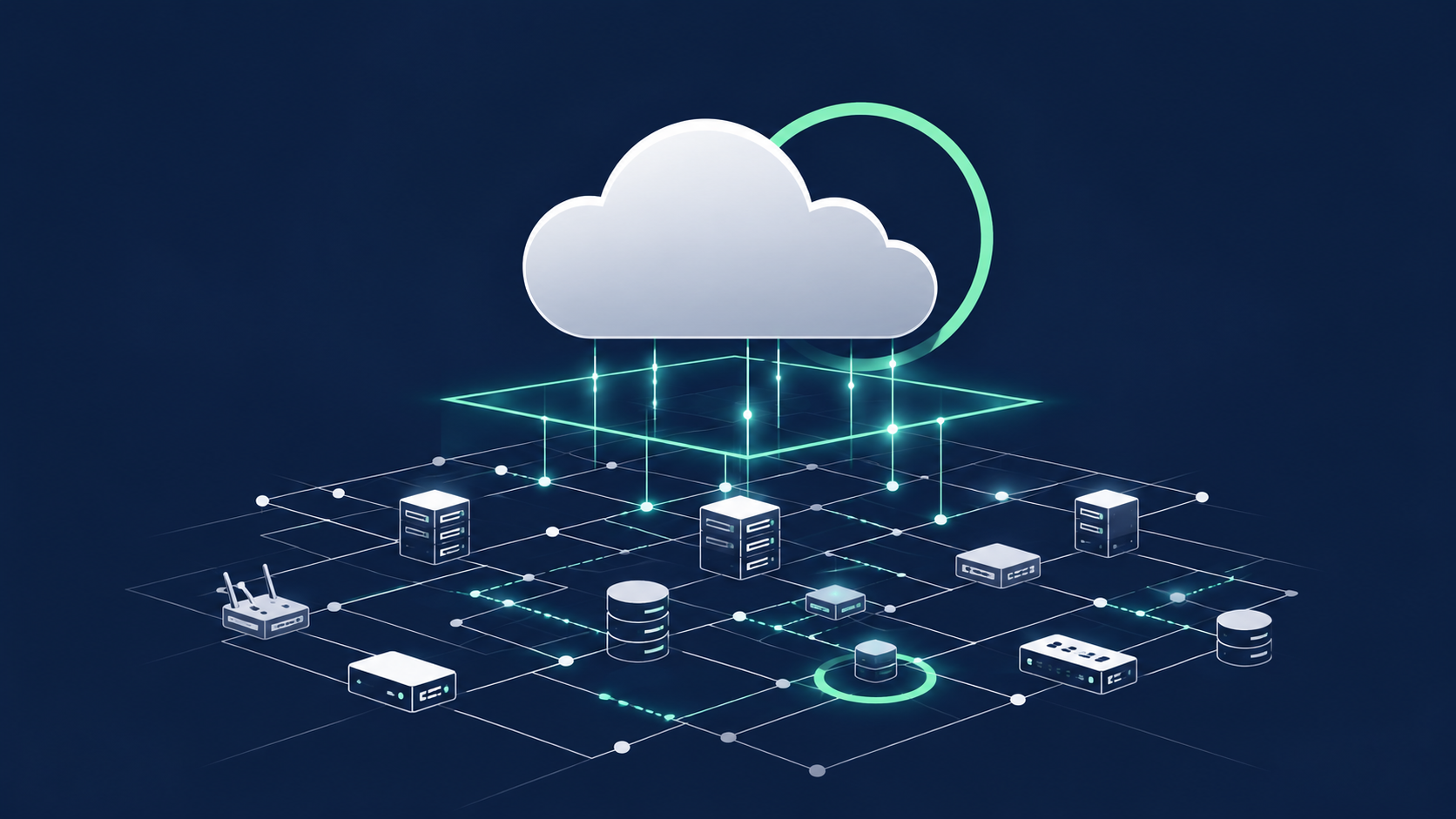
What's frequently missing is a hard look at the physical and network reality the cloud environment will actually run on:
Outdated network infrastructure. A network designed for occasional file transfers and email traffic behaves very differently under sustained, real-time cloud workloads. Latency that was invisible before becomes a daily annoyance once every application call has to travel further.
Bandwidth bottlenecks at the office. Cloud computing shifts load off local servers, but it doesn't shift load off the internet connection. If the office bandwidth was sized for the old way of working, it's now the ceiling on how fast the new environment can actually go — no matter how much compute power sits behind it.
Endpoints that were never optimized. The laptops, desktops, and devices employees use every day are the last mile of the cloud experience. If they weren't reviewed and tuned as part of the migration, they're often the quiet bottleneck nobody thinks to check.
Licenses that were never reviewed. Old licensing structures, tiers, and entitlements don't automatically resize themselves for a cloud-first environment. Left unreviewed, they can silently cap performance or create redundant costs that offset the savings the migration was supposed to deliver.
Wi-Fi that was fine for email, not for cloud workloads. Wireless coverage that comfortably handled inboxes and browsers can fall apart under the concurrent, latency-sensitive demands of real-time cloud applications — video calls, live collaboration tools, cloud-based design or engineering software.
Individually, each of these looks like a minor detail. Together, they quietly cancel out the performance gains a cloud migration is supposed to deliver.
This isn't a rare failure mode — it's a familiar pattern across almost every industry. Leadership approves a cloud budget with a clear expectation: things will get faster, more flexible, and cheaper to run. What often gets delivered instead is a more expensive version of the same slow, frustrating experience teams had before the move.
The reason it keeps happening is structural, not technical. Cloud and infrastructure are usually treated as two separate projects, run by two separate teams, on two separate timelines. The cloud team optimizes the platform. The infrastructure team, if involved at all, is brought in late — often just to "make sure the network can handle it" rather than to shape the migration from the start. By the time anyone notices the gap, the platform is already live, budgets are spent, and the fix becomes a second project instead of a first-time-right build.
At Ouranos Technologies Limited, we start from a different premise: infrastructure and cloud aren't two projects — they're two layers of the same system, and they have to be designed together.
That means before any cloud platform decisions are finalized, we audit the network, the endpoints, and the connectivity that will actually carry the workload. We look for exactly where the current setup will bottleneck a cloud environment — the latency points, the bandwidth ceilings, the coverage gaps, the license inefficiencies — and address them as part of the migration plan, not as a follow-up ticket six months later.
Only once that foundation is solid do we build the cloud platform on top of it. The result is a migration where the platform performs the way it was sold from day one, because the ground underneath it was actually built to support it.
A successful go-live should feel like a successful go-live — not just on the dashboard, but for the people using the system every day.