Every year, thousands of graduates complete trainee programs, collect their certificates, and walk into their first full-time roles still figuring out how to actually do the job. That gap — between "completed a program" and "ready to perform" — is one of the most under-discussed problems in early-career hiring.
It isn't usually the graduate's fault. It's a design problem. Too many trainee programs are built around observation instead of ownership: sit in on meetings, shadow a senior staff member, produce a slide deck at the end to prove you were paying attention. Graduates leave with exposure, not experience. And exposure doesn't transfer to a desk where you're expected to deliver from day one.
If you're a graduate evaluating programs right now, here's what actually separates a program that prepares you from one that simply occupies your time.
Breadth is the point of a rotation — but breadth only means something if you're doing the work, not watching it happen. A good rotation puts you inside real functions with real outputs attached to your name: tickets you resolved, audits you contributed to, content you shipped, a system you helped configure. The test is simple — could you describe, in specific terms, what you built or fixed in each rotation? If the honest answer is "I observed how the team handles X," the rotation didn't do its job.
Strong programs also rotate you across genuinely different functions, not adjacent variations of the same skill set. Moving between technical, operational, and business-facing tracks forces you to develop range early — the kind of range that's hard to build once you're locked into a single specialism a few years into your career.
"You'll have a mentor" is one of the most common promises in a graduate program pitch, and one of the least reliably delivered. Informal mentorship — where you're technically assigned someone but expected to seek them out yourself — tends to collapse under the weight of everyone's actual workload. The mentor gets busy, the trainee doesn't want to be a bother, and the relationship quietly disappears by month two.
Mentorship that actually shapes a graduate's trajectory is scheduled, not incidental. It has defined check-in points, clear expectations on both sides, and — critically — mentors who are accountable for the trainee's development, not just available to it if asked. Ask any program you're considering: how often are mentor check-ins, who sets the agenda, and is mentorship tracked as part of the program's own success metrics? If there's no clear answer, the mentorship is likely aspirational rather than operational.
This is the question that matters most, and the one graduates ask least directly. Some programs are, functionally, a low-cost way to get short-term labor with a graduate-friendly label attached. Others are genuinely built as a pipeline into permanent roles.
You can tell the difference by asking a few pointed questions before you accept an offer: What percentage of last year's cohort converted to permanent staff? Is there a documented path from trainee to full-time role, with clear criteria for what "ready" looks like? Do former trainees currently hold real positions in the company, and can you talk to them? A program with nothing to show on any of these fronts is optimized for headcount, not for you.
We designed the Ouranos Graduate Trainee Program around these exact gaps, because we've seen how costly they are — for the graduate and for the business that eventually hires someone who "completed a program" but still needs a year to get productive.
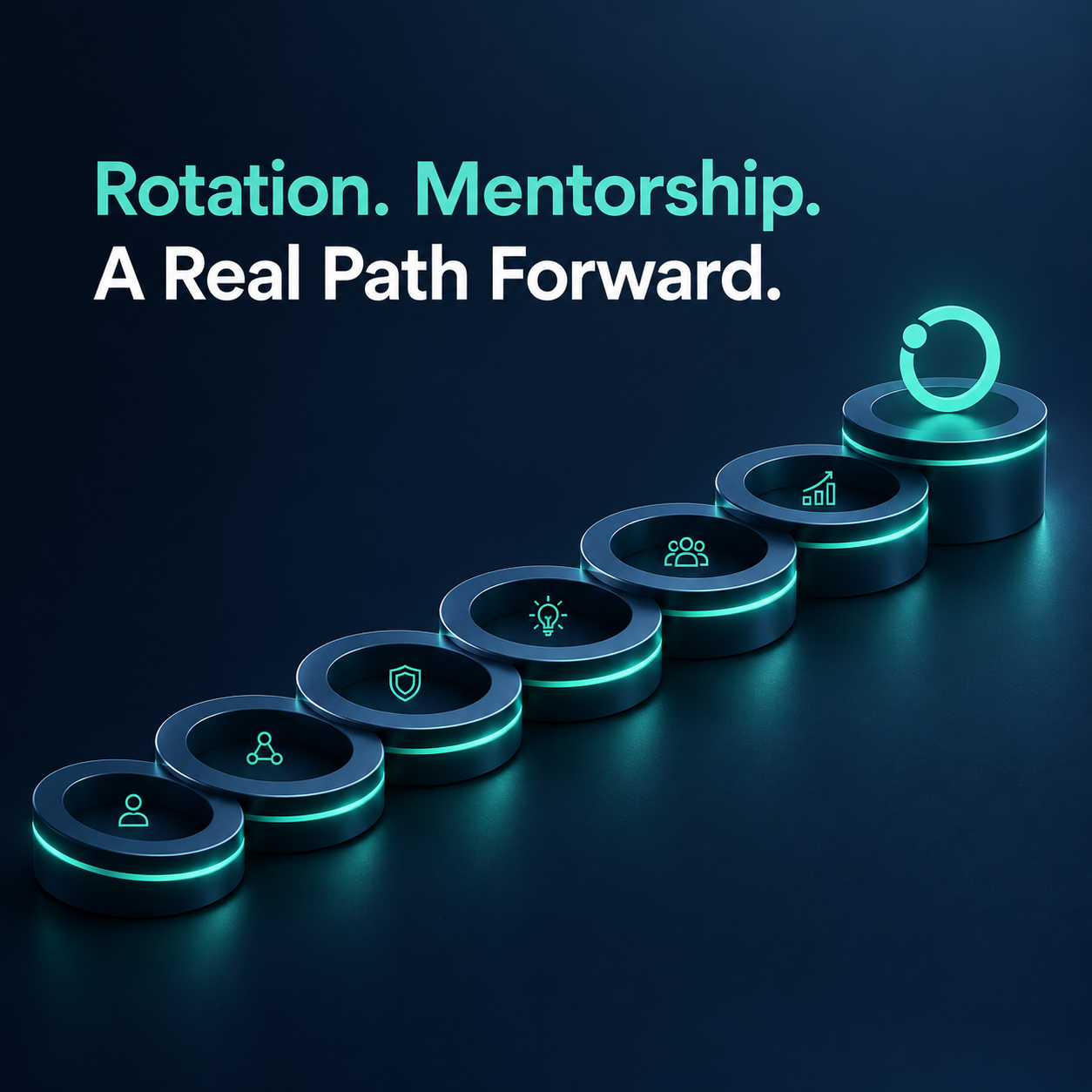
Trainees rotate across all seven GT tracks — IT Network, IT Security, IT Infrastructure, Internal Audit, Research & Development, Value Management, and Marketing & Customer Support — with real ownership in each, not observation seats. Mentorship starts on day one and is structured into the program itself, not left to chance or individual initiative. And the program has a defined path to a permanent seat at Ouranos, with clear expectations set from the start about what conversion looks like.
If you're evaluating graduate programs, use the questions above on every option in front of you — ours included. A program that can't answer them clearly isn't ready to invest in you the way it should.