Many organizations don’t realize their IT is costing them more than it should—until something breaks.
A system outage, a security incident, or even persistent inefficiencies can quickly expose gaps that have been overlooked for years. In today’s business environment, where operations, customer experience, and revenue are tightly tied to technology, reactive IT management is no longer sustainable.
This is where strategic IT advisory becomes essential.
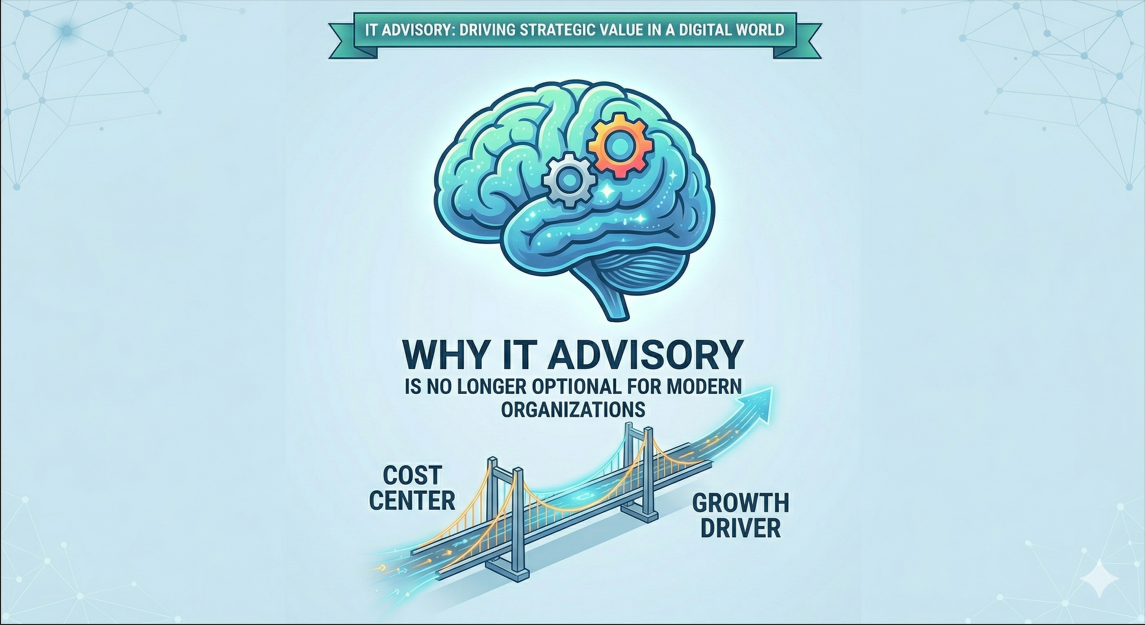
Rather than responding to issues after they occur, IT advisory enables organizations to take a proactive, structured approach—aligning technology decisions with business goals and positioning IT as a driver of growth, not a source of disruption.
Aligning Technology with Business Objectives
One of the most common challenges organizations face is a disconnect between their technology and their business priorities.
In many cases, systems are implemented over time without a clear long-term strategy, leading to fragmented environments that slow down operations rather than support them.
IT advisory addresses this by providing clarity and direction. Through structured assessments and strategic planning, organizations can identify what is working, what is not, and what needs to change.
The result is a cohesive IT environment where every investment supports defined business outcomes—whether that is improving efficiency, enabling growth, or enhancing customer experience.
Driving Cost Efficiency and Maximizing Value
IT costs often increase gradually and without clear visibility. Multiple tools performing similar functions, outdated systems that require constant maintenance, and unplanned fixes all contribute to unnecessary spending.
We frequently see organizations investing in technologies that deliver limited value simply because there is no framework guiding decision-making.
With the right advisory approach, businesses can:
This shifts IT spending from reactive and fragmented to strategic and value-driven.
Enhancing Governance and Risk Management
As technology becomes more central to operations, the risks associated with poor governance continue to grow.
Data breaches, compliance failures, and lack of visibility into IT processes can have serious financial and reputational consequences. Yet, many organizations still operate without clearly defined governance structures.
IT advisory helps establish a solid foundation by:
This proactive approach not only reduces risk but also strengthens stakeholder confidence.
Building Resilient and Secure Systems
Downtime is no longer just an inconvenience—it directly impacts revenue, productivity, and customer trust.
Despite this, many organizations are still unprepared for disruptions, relying on reactive fixes rather than proactive planning.
IT advisory focuses on building resilience into the core of your technology environment through:
This ensures that when disruptions occur—and they will—your organization is prepared to respond effectively with minimal impact.
Enabling Scalability and Sustainable Growth
Growth introduces complexity, and without the right IT foundation, that complexity can quickly become a barrier.
We often see organizations struggle with systems that cannot scale, leading to inefficiencies, delays, and missed opportunities.
Through IT advisory, organizations can design technology environments that are:
This creates a stable platform for expansion while maintaining operational efficiency.
The role of IT within organizations has fundamentally changed. It is no longer sufficient to manage technology reactively—IT must be approached as a strategic asset that directly influences business performance.
Organizations that take a proactive approach through IT advisory are better positioned to reduce costs, manage risks, and build resilient systems that support long-term growth.
At Ouranos Technologies Limited, we work closely with organizations to turn complex IT challenges into clear, actionable roadmaps—grounded in real operational needs, not assumptions. Our focus is not just on recommending solutions, but on ensuring those solutions deliver measurable impact.
The question is no longer whether your organization needs IT advisory—but whether your current approach is positioning you for growth or quietly holding you back.